INSIDE THE FLAT TV: FUJITSU PDP TECHNOLOGY
Unlike conventional, deep cathode ray tubes (CRT), the heart of flat-tv.com is based on the revolutionary three-electrode surface discharge technology.
• Model: Fujitsu FPF42C10660UC-03 (Manufactured: April 1998)
• Resolution: 852 x 480 Pixels (Progressive VGA)
• Panel Depth: Only 11.4 cm (4.5 inches)
The Physics of Luminescence: Neon-Xenon Matrix
Every single pixel is divided into three subpixels (Red, Green, Blue). These tiny chambers are filled with a highly precise, balanced noble gas mixture of Neon and Xenon.
By applying a high-frequency sustain voltage via the massive X- and Y-Sustain driver boards, the gas is excited into a high-energy plasma state. The resulting ultraviolet (UV) radiation—invisible to the human eye—strikes a high-efficiency phosphor layer inside the chamber, causing it to emit visible light in its respective primary color.
Late 90s Overengineering: The FTV1.5E Chassis
The chassis of the Philips 42PW9982 stands as a monument to uncompromising engineering. To prevent signal degradation and interference, all core video processing is housed in a massive, external System Box, leaving the panel to operate as a pure, minimalist monitor.
The internal driver stages and power supplies within the panel housing operate under immense thermal stress. For this reason, Philips utilized advanced phosphor formulations bonded to special High Strain Point Glass in the analog FTV1.5E chassis. This glass was baked at extreme temperatures to withstand the natural aging of the gas discharge cells over decades. The result is a rock-solid, vibrant image that has lost none of its analog fascination after more than a quarter-century.
The Turn-of-the-Century Media Archive
To fully document this era, the official media collection of the legendary Siemens Mobile Wave Tour 2002 has been integrated into the archive. These contemporary documents serve as reference material for video and audio performance tests on the Philips Plasma:
• Vienna 1 & 2: Highlight Show & TV Broadcast Version (2x 26 Min. PAL)
• Photos Vienna 2002: Official Press CD by Richard walch
Historical US Launch Artifact (1998)
A look back at the original North American newspaper advertisement for the sister model marketed under the Philips Magnavox luxury brand (Model 42PW9962). This contemporary document serves as living proof of the incredible high-end status and uncompromising audio architecture of this system.
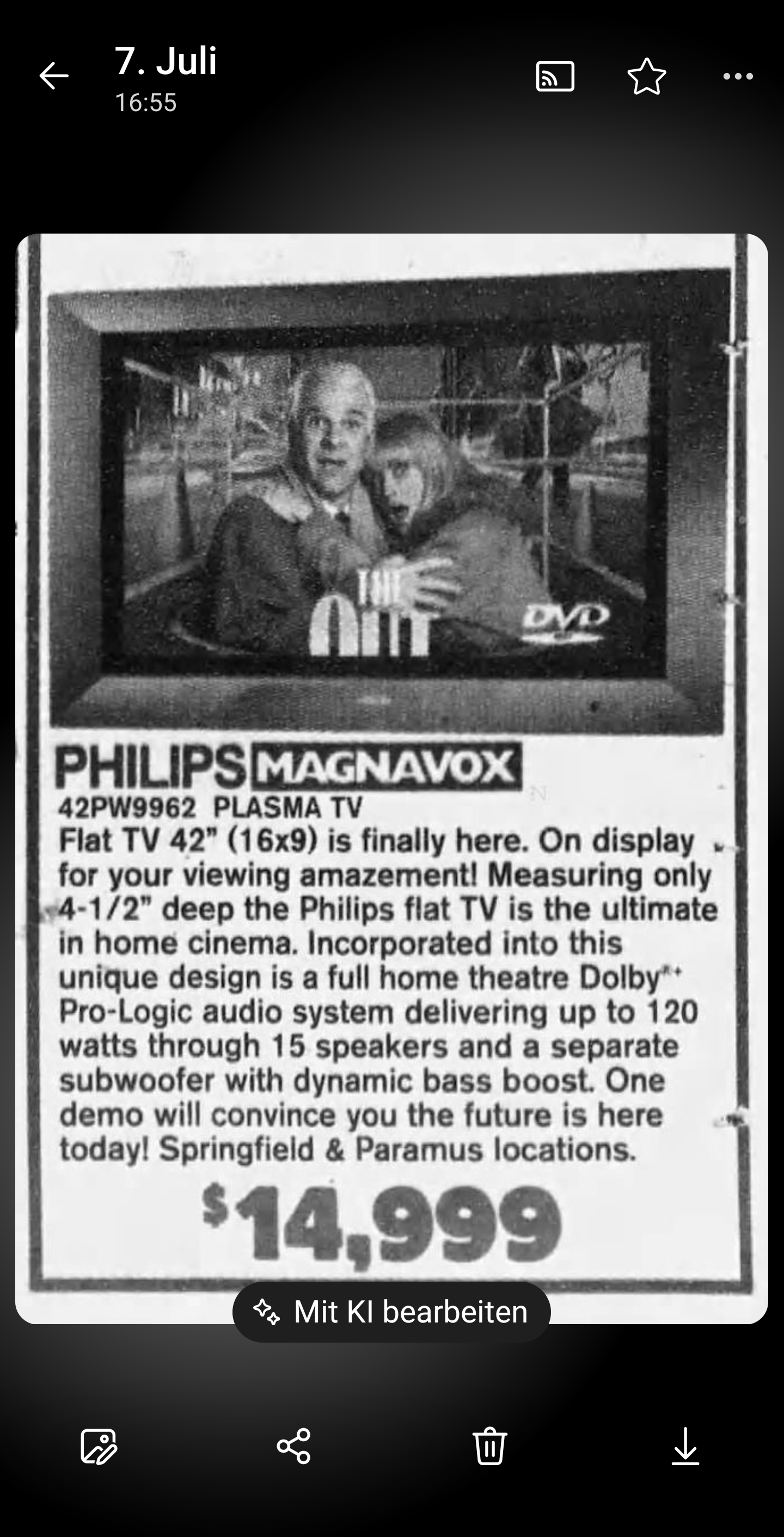
The official launch price tag: $14,999 USD. Promoting Steve Martin's "The Out-of-Towners" on the brand new DVD format.
THE SOUND MONSTER: 15-SPEAKER ACOUSTIC ARRAY
While modern ultra-thin televisions sacrifice audio quality for slim bezels, the Philips 42PW9982 is a heavy-duty audio powerhouse. Built at a time when home theater meant zero compromises, the audio engineering in this system behaves like a high-end dedicated HiFi speaker setup.
• Total Power Output: 120 Watts RMS (True analog amplification)
• Audio Architecture: 15 Integrated Speakers in a multi-array layout
• Sound Processing: Dolby ProLogic & Spatial Stereo Matrix
Isolated Baffle Chambers & Long-Throw Drivers
The jaw-dropping soundscape of the 42PW9982 is achieved through genuine physical resonance volume. Inside the heavy, reinforced cabinet, Philips integrated fully isolated, rigid acoustic chambers (Baffles). These enclosures act exactly like professional bookshelf speakers, allowing the specialized long-throw oval drivers to move massive amounts of air without rattling the sensitive electronics of the plasma driver boards.
The fabric surrounds (Gewebesicken) of these drivers were manufactured to extreme high-end standards. Even after nearly three decades, they show zero signs of foam rot or degradation, delivering an incredibly warm, punchy bass foundation and razor-sharp vocal presence directly out of the television's front array.
The 15-Speaker Matrix & External System Box
The amplification and matrix routing are driven by the massive, external System Box. It splits the analog audio tracks into a complex array. By utilizing fifteen separate transducers strategically angled across the system, it projects a massive, sweeping soundstage that creates a physical Dolby ProLogic surround experience without the immediate need for external satellite speakers.
Whether it is the roaring V8 engine of an E46 M3 GTR or the deep bass tracks of early 2000s event footage—the analog power amplifiers deliver a dynamic punch that leaves modern digital soundbars far behind.